Showing posts with label Epicurus. Show all posts

Monday, February 14, 2011

What Everyone Ought to Know about Stoic Thought on the Emotions

A brief background on the Stoics


If you say someone is stoic, you’re almost certainly giving them a compliment, specifically that they stood strong in the face of a very bad situation. And with that sort of good PR, its probably not a surprise that Stoicism is a very popular search term on Google. In fact, ‘Stoicism’ gets 56% more hits than ‘Platonism’ and 469% more hits than ‘Aristotelianism’.  Now, a lot of this is likely due to the facts that people usually search for ‘Plato’ instead of ‘Platonism’ and ‘Aristotle’ instead of ‘Aristotelianism’ and relatively few people know that Zeno of Citium founded Stoicism or even that its most well known exponent was Epictetus.


Still, the fact is that Zeno and Epictetus created and spread a philosophy that is quite famous and well respected even to the present day. That certainly deserves a lot of respect. And I highly recommend anyone interested in how ethical philosophy influenced modern religions study the Stoics. I can't think of a philosophy closer to Christianity than Stoicism.


Zeno of Citium, Founder of Stoicism
Here are four stoic books I can happily recommend:

Discourses - Epictetus
Enchiridion – Epictetus
The Meditations – (Personal journal of Stoic and Roman Emperor Marcus Aurelius)

Marcus Aurelius
With all that said, let me go a head and put it on the table that I’m going to be highly critical of the stoic view of the emotions. But before that, a little more background.


Zeno the Stoic, a near contemporary of Epicurus (341 B.C.), was born in 334 B.C. 13 years after the death of Plato (347 B.C.) and about 20 years before Aristotle died (322 B.C.). Zeno probably never met Aristotle but almost certainly knew Epicurus very well. In fact, many people think Zeno set up his school specifically as a counter to Epicurus’ school.

Be that as it may, the sad thing is all of Zeno’s writings are lost. As a result, we typically turn to the Roman stoics to study Stoicism. (No doubt that its huge importance in Rome, coupled with the Western World’s subsequent fascination with Ancient Rome, has played a major role in making Stoicism popular to this day).


Epictetus - The spokesman for Stoicism

It is not very controversial to say that the most compelling, most well regarded source of Stoicism we have is the works of Epictetus. Not only was he a very clear writer and consistent thinker, but his life story is also quite compelling. Unlike so many of the great philosophers before him, Epictetus was not a wealthy man. In fact, he was born and raised a slave, and suffered from a permanent physical disability that left him with a pronounced limp. However unfortunate you judge those limitations to be, he had the relative benefit of being the slave of a very important Roman administrator and thus received an excellent education, focused squarely on Stoic philosophy. And he did eventually gain his freedom.


The fundamental Stoic beliefs regarding the emotions


The Stoic philosophy of emotion builds on three fundamental claims. The first, absolute bedrock idea is that


Emotions are identical with judgments

The other two fundamental beliefs are that

Emotions are voluntary

And that

Emotions should be eliminated

Just to be clear, what they believe is that like when you feel happy or sad, it is exactly the same sort of mental process as when you decide someone is boring or that you would prefer cheeseburgers to doughnuts. And that these choices, the decisive opinions, are completely up to you and no one else. No one can make you prefer cheeseburgers and no on can make you angry. Only you can decide. Finally, you should not have any emotions.

You probably noticed that that last bit doesn’t exactly follow logically. I mean, just because of the fact that emotions are choices that you make and that only you can make, it doesn’t mean that you shouldn’t have them. After all, they certainly don’t think you should have no judgments at all! So to understand the Stoics on the emotions we need to understand why emotions are not the kind of judgments you should have.

According to the great Cicero, a very famous Roman statesman, philosopher and legal scholar and in my opinion one of the 2-3 most brilliant Ancient Romans, who was often but not always an advocate of stoic teachings, the Stoics “refuse to concede that a person ought to have any feelings at all”. 


And he’s right, the Stoic position on emotions is quite simply that they are bad and must be completely excluded from life if a person ever wants to be good and happy. As you may have already figured out, I find this conclusion completely misguided, and easily the least satisfactory account of the emotions in the ancient world. I’ll argue that the Stoic philosophy of emotions was guilty of egregious errors that, due to Stoicism’s pervasive influence for subsequent thinkers, have done an extraordinary amount of damage to our understanding of the emotions and so to our ethical thinking.

More specifically, I’m going to show you how Stoicism was the starting point for the fundamental flaws present in what today we’d call “cognitive” theories of emotion and motivated the fundamental flaws present in what today we’d call “physicalist” (I call them visceral) theories of emotion.

Next week I'll begin laying out Epictetus' "handbook for Stoicism", the Enchiridion

Monday, February 7, 2011

How to Understand The Epicureans on Emotion, Part II of II

As I explained in the last post, Epicureans believe that we all have a fundamental desire to pursue pleasure, and that to fulfill this desire, we'll actually sometimes have to avoid some pleasures. Specifically, we need to avoid pain-creating pleasures (e.g. doing hard drugs) and even pursue pleasure-creating pains (e.g. taking awful-tasting medicine).

That's certainly a tough lesson for many to learn, but it has the ring of truth to it, and, at least in my case, experience says it's often true. Perhaps you're one of the lucky ones who think all this is rather obvious and that there's not much to see here. Either way, lets look a little deeper because there's plenty more to see.

Do we really ALWAYS act to avoid pain and fear / to get pleasure?

Taking the claim that we always act to seek pleasure / avoid pain at face value may seem at times brilliantly simply and at other times a cliché or an uninformative tautology.

Consider the following:

1. Pleasure is the avoidance of pain

2. All action is to avoid pain

3. If its true that when our desires are eliminated, we do not act, then when we eliminate pain, we do not act until there is another possibility of removing pain.

That is, it appears what we're agreeing to is that when we succeed in eliminating pain, we cease to have desires, and so we cease to have any reason to act, so we don't act.

Does that have the ring of truth or sound like a tautology? Hardly. Its actually a strange thing to consider. I mean, I can imagine you could argue that someone in a drunk stupor, high on drugs, having just achieved orgasm or having completed a delicious meal could be 'sated' in such a way as to have no desire to do anything.


Homer, having achieved the absence of pain, ceases to act

For a time. Specifically, until some other 'pain' interferes with our state of repose.  But then all we really seem to have learned is that we'll always be hungry and that the effort to satisfy certain hungers will pay off longer or better than others. But Plato and Aristotle already made that very clear.

So what in the world are we really saying in agreeing with the 'obvious' truths that pleasure is the absence of pain and all action is to avoid pain?

What's really happening here?

Ask yourself this - what actually happens when you, by luck or by careful planning, act in a way that truly maximizes your pleasure?

The first thing that occurs to me in asking myself that is that in such cases its highly likely that it involved a lot more than a stroke of luck, my brain - more or less consciously - was deeply involved. And the more such 'maximized pleasure' moments one has, the more likely it is that more than just luck was involved.

So the first thing I'd feel good about concluding is that some of the times that I really maximize my pleasure require a bit of thought. But I also have to accept that other times its more the case that I fell back on some training - which may have required thought in the past, but little now.

For example, the goal of having a tasty snack is a simple, good goal. It doesn't require a whole lot of thinking. But in fulfilling it you do have to have the implicit awareness that not everything that looks tasty is tasty.

So when reaching into the cookie jar for some Oreos, you might recall the time you accidentally got some nasty off-brand cookie and so double check what you pulled out this time. That would be 'goal awareness' plus 'realizing' or 'knowing' that looks can be deceiving.

The epicurean maxims we've been discussing can handle this. And actually, thats nice - in a way they are saying we can judge without deliberating. That's a good thing, and its in agreement with P-A-L. But there's going to be a few problems.

Let's quickly note that Plato, Aristotle, Lucretius and Epicurus all basically agree on some key points:

1. Every action is done for the sake of getting to some ultimate end. Depending on who you ask, that the ultimate goal could be said to be accumulating wealth, political power, sexual conquests, or perhaps a life of the mind.

2. But as far as the philosophers I noted above, they're all pretty much in agreement that the ultimate end isn't really any one of those things but rather happiness. A major caveat - each one of the philosophers mentioned has subtle and interesting differences in just what happinessis.

3. They do, however, stand in agreement that achieving happiness is mostly up to us and requires us to be virtuous. But that means that they also agree that being happy requires some level of control over our desires.

The issue, as I tried to make plain at the beginning of this project, is that its going to take a solid understanding of human psychology to determine  what makes humans happy in general, and what will make you happy.

Not a rhetorical question: Just how far does 'all action is for the avoidance of pain' go in that direction?

Identifying the Problems Epicureanism has with Emotion

Epicurus strikes out from this basic agreement with P-A-L do to his thoughts on how to deal with the fact that we sometimes choose to act in ways that do not give us what we seek, pleasure, but instead give us the opposite.

Epicurus thinks that when we act so that we end up in real pain, its caused by both chosen/conscious actions and by reflexive actions,including emotion-driven actions, even though we never intend for this to happen.

Remember, we always seek pleasure, we always act to get pleasure. When the emotions sometimes lead you to pain, they make you wrong about the outcome your actions will lead to.

That is, emotions cause you to think improperly, to be mistaken about the facts of the matter, and so to incorrectly choose what will bring you pleasure. Not only that, acting emotionally is sometimes choosing to act in ways that do not give us what we seek, but instead give us the opposite.

As such, emotions need to be eliminated. They're just too dangerous. And they, on the surface at least, contradict a major Epicurean tenet - that we always act to pursue pleasure.

Rhetorical question: Is happiness an emotion or isn't it?

Let's be clear - Epicurus thinks that when we fail to achieve pleasure, we chose to act for pleasure but were wrong about what we thought we'd achieve. After all, we to some extent  always chose to act.  Similarly, Epicurus also believes that even more or less unchosen acts that lead to real pain (not pleasure-creating pains) are the opposite of what we 'wanted' to achieve.

That is, whether or not we are acting in 'full choice', or acting 'instinctively' or 'reflexively', act that induce real pain are errors. And we definitely want to be conscious of what motivates our chosen actions, as this will help avoid future errors. So he counsels that we hone our abilities to control 'instinctual' or 'reflexive' acts taken to avoid pain.

But are we ever going to consistently get what we want - no pain or fear - by listening to Epicurus' advice that only the proper pursuit of necessary desires will ensure our desires are truly fulfilled?  That is, can we and should we act exclusively and correctly for the repose of the mind and body and nothing more? That's certainly the prescription.He encapsulates all this when he says “the pleasant life comes from searching out the motives for all choice and avoidance, and banishing mere opinions (like many emotions), to which are due the greatest disturbances of the spirit”.

Conclusion

Alright, I've been slow-playing my criticisms of Epicurus' take on the emotions and how they influence his moral philosophy but its time to play my hand.

The emotions are real trouble for Epicurus' theory for the simple reason that a person's success at understanding and controlling the emotions will determine how good an epicurean she will be.

Epicurus agrees with Plato and Aristotle that in some situations, certain emotions will prove exceedingly difficult to avoid. At its core Epicureanism is advising us that only a small subset of our desires - the natural and necessary - is at all necessary for and conducive to happiness. That's why Epicurus insists we understand the types of desires. Knowing what's what will allow you to act in a way so as to have and maintain a healthy body and a mind free of disturbance. And because of the fact unmodulated or ungoverned emotions can work powerfully against this goal, he wants to throw the baby out with the bathwater and eliminate emotions.

The problem for Epicureanism as a guiding moral philosophy, what leads it to this conclusion, stems from the fact that for most people who might try to be epicureans precious little of what we do is a result of conscious deliberation. And thus to make it work we're going to have to find some way to train ourselves to act appropriately in cases where we're not consciously considering the true nature of the desire we're dealing with. But how is this training supposed to work? How do you raise a child this way and how do you reverse-engineer it in a mature adult?

I'll remind you one last time that according to Epicureanism, young or old, educated or ignorant, we always act to achieve happiness or pleasure, to avoid pain or fear. But just what does that mean when we in fact do not often consciously think about our actions and what is really motivating our desires?

It means that we often get tricked. It means that in order for most of us to really be happy, somehow we must both consciously and non-consciously avoid errors in determining what is actually best for us, what we really need to do and what only seems necessary.  We need some mechanism or mechanisms to make sure we only pursue the absolutely necessary desires, no matter our level of conscious attention. Unfortunately, Epicurus refuses to accept what Plato, Aristole and Lucretius did - the emotions can be just such mechanisms.

In order for normal people like us to succeed as epicureans given our limitations in concentration, we need to be trained. This is not news, and in fact, as you no doubt have noticed society does do a lot of training through the mores it passes along. So does organized religion. For example, until quite recently, society trained homosexuals to repress their sexuality, at the cost of tremendous stress and unhappiness. Many religions still do.  And more positively, traditional sexual expectations for heterosexuals, though also stressful, perhapsworked to lower infidelity in marriage and by extention lowered the rate of divorce, arguably providing better homes for young children.

But how do such mores work? The way they are passed on, usually in childhood, makes it pretty clear they are not appealing to our rational faculty. We don't get logical or philosophical arguements for the rules of society or religion. Instead it seems clear that the emotions, including pride, fear, shame, anger and the need for love are deeply involved. Much more than involved.

In reality, we know it to be true from experience - it just makes sense - that properly calibrated emotional responses to situations are exactlythe efficient, practical, successful mechanisms by which we can increase the likelihood that we can have the well-trained character that would help us approach the goal of desiring only what is truly going to make us happy.

However, Epicureanism not only discourages this, it flatly claims that strong emotions are to be completely eliminated and generally speaking, all emotions should be eradicated. Even though Epicurus had the benefit of studying Aristotle's thinking on the matter which fleshes out convincingly the idea that in some cases its highly desireable,correct even, for you to strongly feel specific emotions.

As I think Plato, Aristotle and Lucretius made plain, and as I'll explain in greater detail later, the emotions are exactly the sort of thing to strongly influence you to act quickly and assertively to achieve a desire you're body thinks is necessary. Its unquestionable that to perform this service they need a significant level of monitoring. I argued that this insight is at the core of Plato's psychology. Epicurus, to his discredit, misses this point.

For him, the emotions are so powerful and damaging that they simply offer too much of a chance for error and so simply offer too much likelihood for pain. And the successful 'emotion-controller' would have to be already nearly perfect in character not to succumb to negative impulses. Thus Epicurus says we need to eliminate them.
But this is an unrealistic goal, and given the tremendous force for good education and action that the emotions in fact can be, its an unworthy goal.
The emotions are not a problem to be avoided, or a rough patch to be smoothed. They are an integral part of our organism that needs to be enhanced.


Tuesday, November 2, 2010

Epicurus and the Epicurean Philosophy, pt 1 of 2

Introduction

 
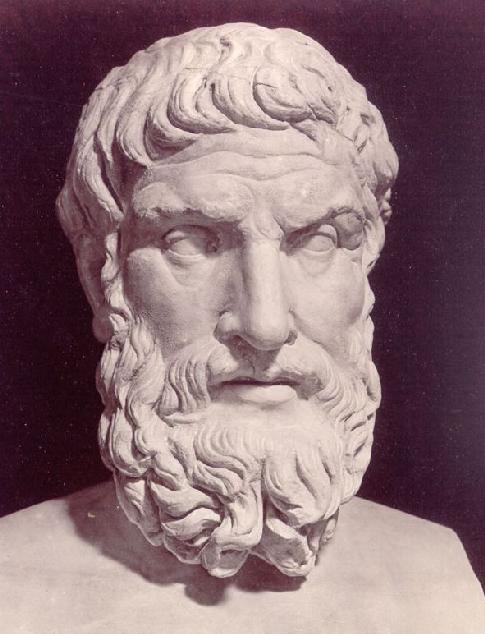
Epicurus, the first Epicurean
Epicurus, born 7 years after Plato died, was the founder and namesake of the Epicurean philosophy. But let's be clear from the top that he is definitely not the sort of epicurean you probably think of when you see that word.

 
Modern 'epicurean'
Still, there's a lot of great things to be said for the old-school epicureans too. For instance, Lucretius already showed us some very important epicurean concepts, such how strict they were about physicalism. And I tried to show how clearly what Lucretius said about psychology, thinking and the emotions fit in just fine with Plato and Aristotle's thoughts on the matter.

Happily, a lot of what we've already said will count for Epicurus too, and so epicureanism in general. But not everything. There are some fundamental beliefs held by Epicurus that I think end up derailing his take on the emotions. So, at the end of the day, the theory I'm putting forth doesn't turn into the P-A-L-E theory, but remains the much better-sounding P-A-L theory.
Lets start with some good stuff before attacking the bad stuff.

Core Epicurean Beliefs about Psychology

The most fundamental thing about epicurean psychology  is the idea that there are 3 types of desires, and they are what motivate us to act. The types are

1. Natural and necessary
2. Merely natural
3. Vain

Of course you knew it would be more complicated than that. Actually, category 1 has 3 sub-types that need to be understood, (category 2 and 3 don't have sub-types). The sub-types of "natural and necessary" desires are

1. Desires necessary for happiness
2. Desires necessary for rest or peacefulness of the body
3. Desires necessary for life

The reason these are so fundamentally important is that Epicurus was convinced that properly understanding what motivates your actions  would allow you to make all your choices for the sake of

1. The health of the body
and
2. Keeping the psyche free from disturbance

In a nutshell, if you know what motivates you to act, you can learn to act only for the sake of mental and physical repose.

 
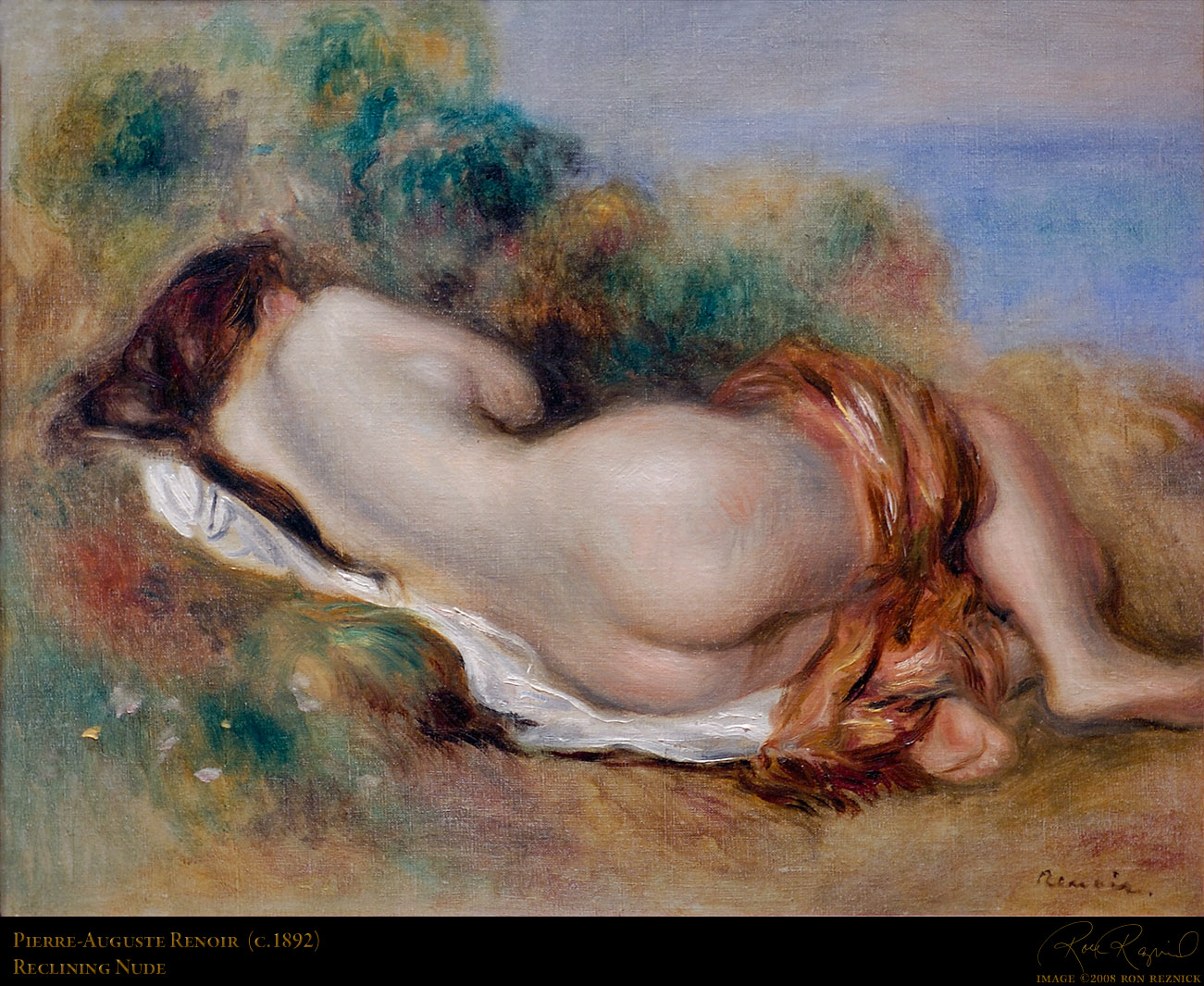
Renoir's "Reclining Nude", sometimes called 'Repose'. I think it captures a bit of both ancient and modern epicureanism. I wonder what she's reading!
Epicurus on Choice

A fundamental belief in epicureanism is that we ALWAYS act to avoid pain and fear. Its just a matter of whether our choices are properly in line with that fact. Ideally, we choose consciously to act so as to avoid pain and fear, and at the same time for the sake of mental and physical repose.  In the end avoiding pain & fear is the same trying to get repose. We can therefore say that when we're doing well we correctly chose to act in order to avoid pain & fear, or that we choose to act so as to have a healthy body and a mind free from disturbance, and mean the same thing.

Its important to note that we're not talking about reflexive responses to fear or pleasure stimuli, certainly not essentially such responses. For instance, in their way of looking at it, fear is an anxious anticipation of something you know is coming.

So while its not right to say that everything we do to achieve this goals is consciously chosen, we do have the ability to be conscious of all things that motivate all the choice-behavior and avoidance-behavior we end up doing. For instance, I may not choose to respond negatively and aggressively when a stranger puts an empty beer glass on my table as he walks by, but I chose to have a drink, I chose to go where I ended up, and as such I presumably chose to be around people who would do such things. When I then act to avoid the pain of being publicly diminished in that way, it shouldn't be too surprising.

Clearly, if I decide that the stranger deserves a beer dumped on them, I've made a bad choice. Yet my actions were an attempt to avoid pain.
 
In what way did Darius choose to get beat up?
 
But how much of  of the things that motivate counter-productive efforts are going to be really chosen in the fully aware way I might, after staring at a draught beer list chose one beer over all the others?

Epicurus would counsel us to recall that there are three types of desires. One type, vain desires, are not "automatic" or "reflexes", ever. We only have them because we in some strong sense of the word chose them.  If you really have to get a Duvel over an Amstel, its not because of some fundamental need of human beings.

Other desires, the merely natural ones, come to us in a sense automatically, like the desire to have something to drink (I don't mean a 'thirst' where you are parched). But we can choose to ignore them almost completely, at least for a time.

And  as for the necessary desires, such as for sustenance, hydration or sleep, though they certainly must be satisfied, we still have a pretty good degree of leeway as to just how or to what extent we will satisfy them beyond the level absolutely required for physical and mental repose. I mean, yes you have to eat, but whether you skip a few meals or add a few extra is up to you.

So in the end, to a very large degree, pretty much everything you do, at least the way in which you do it, is up to you. Even if as a matter of fact you aren't "consciously' choosing to do the thing you are doing at any particular time.

Let's review. According to Epicurus, whether an action is consciously chosen or not, we ALWAYS act to avoid pain and fear.

This conclusion is based on three assumptions so we better see what we think of them.

1. Pleasure is the first good and natural to us. (The number one and original thing everyone seeks out is pleasure).
2. Every pleasure is good, but not every pleasure is something you should choose to get. (Just because sex is good doesn't mean you should sleep with everyone who will sleep with you).
3. Though every pain is an evil, some should not be avoided.

As it turns out, in Epicurus' mind, #2 and #3 are the same point. After all seeking pleasure is avoiding pain, and avoiding pain is seeking pleasure. So if there are some things you shouldn't do, its because they will somehow get rid or pleasure or cause pain even though you'd think they'd do the opposite.  Pleasure, at the end of the day, is "freedom from pain in the body and from trouble in the mind". And we know from experience that some pleasures do lead to pain, and that some pains lead to pleasure. If you're not sure of the last one just think "flu shots" or "blood sample" or even "Listerine".

But the point here is that epicureans believe that if you agree with them that pleasure is the first good, to fulfill your natural desire for pleasure, you will have to avoid some pleasures to get pleasure. We need to avoid "pain-creating pleasures" and even purse "pleasure-creating  pains".

I think that's already a good lesson but if it seems obvious to you, don't worry. I assure you its deeper than that. To see how smart this actually is, next time we will consider what it really means that we ALWAYS act to avoid pain and fear and to get pleasure.