Showing posts with label From my dissertation blog. Show all posts

Tuesday, November 2, 2010

Epicurus and the Epicurean Philosophy, pt 1 of 2

Introduction

 
Epicurus, the first Epicurean
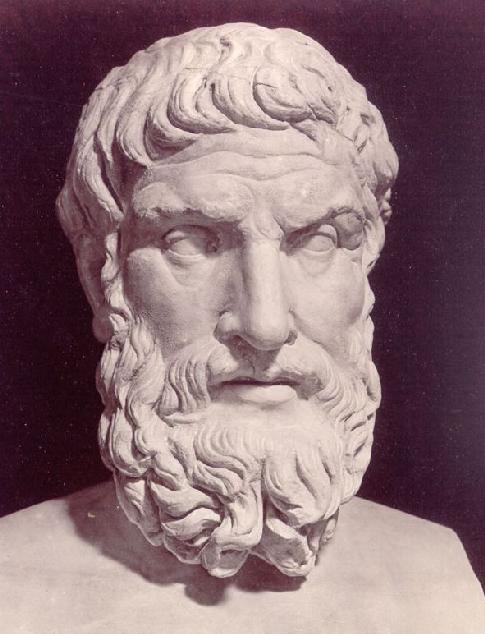
Epicurus, born 7 years after Plato died, was the founder and namesake of the Epicurean philosophy. But let's be clear from the top that he is definitely not the sort of epicurean you probably think of when you see that word.

 
Modern 'epicurean'
Still, there's a lot of great things to be said for the old-school epicureans too. For instance, Lucretius already showed us some very important epicurean concepts, such how strict they were about physicalism. And I tried to show how clearly what Lucretius said about psychology, thinking and the emotions fit in just fine with Plato and Aristotle's thoughts on the matter.

Happily, a lot of what we've already said will count for Epicurus too, and so epicureanism in general. But not everything. There are some fundamental beliefs held by Epicurus that I think end up derailing his take on the emotions. So, at the end of the day, the theory I'm putting forth doesn't turn into the P-A-L-E theory, but remains the much better-sounding P-A-L theory.
Lets start with some good stuff before attacking the bad stuff.

Core Epicurean Beliefs about Psychology

The most fundamental thing about epicurean psychology  is the idea that there are 3 types of desires, and they are what motivate us to act. The types are

1. Natural and necessary
2. Merely natural
3. Vain

Of course you knew it would be more complicated than that. Actually, category 1 has 3 sub-types that need to be understood, (category 2 and 3 don't have sub-types). The sub-types of "natural and necessary" desires are

1. Desires necessary for happiness
2. Desires necessary for rest or peacefulness of the body
3. Desires necessary for life

The reason these are so fundamentally important is that Epicurus was convinced that properly understanding what motivates your actions  would allow you to make all your choices for the sake of

1. The health of the body
and
2. Keeping the psyche free from disturbance

In a nutshell, if you know what motivates you to act, you can learn to act only for the sake of mental and physical repose.

 
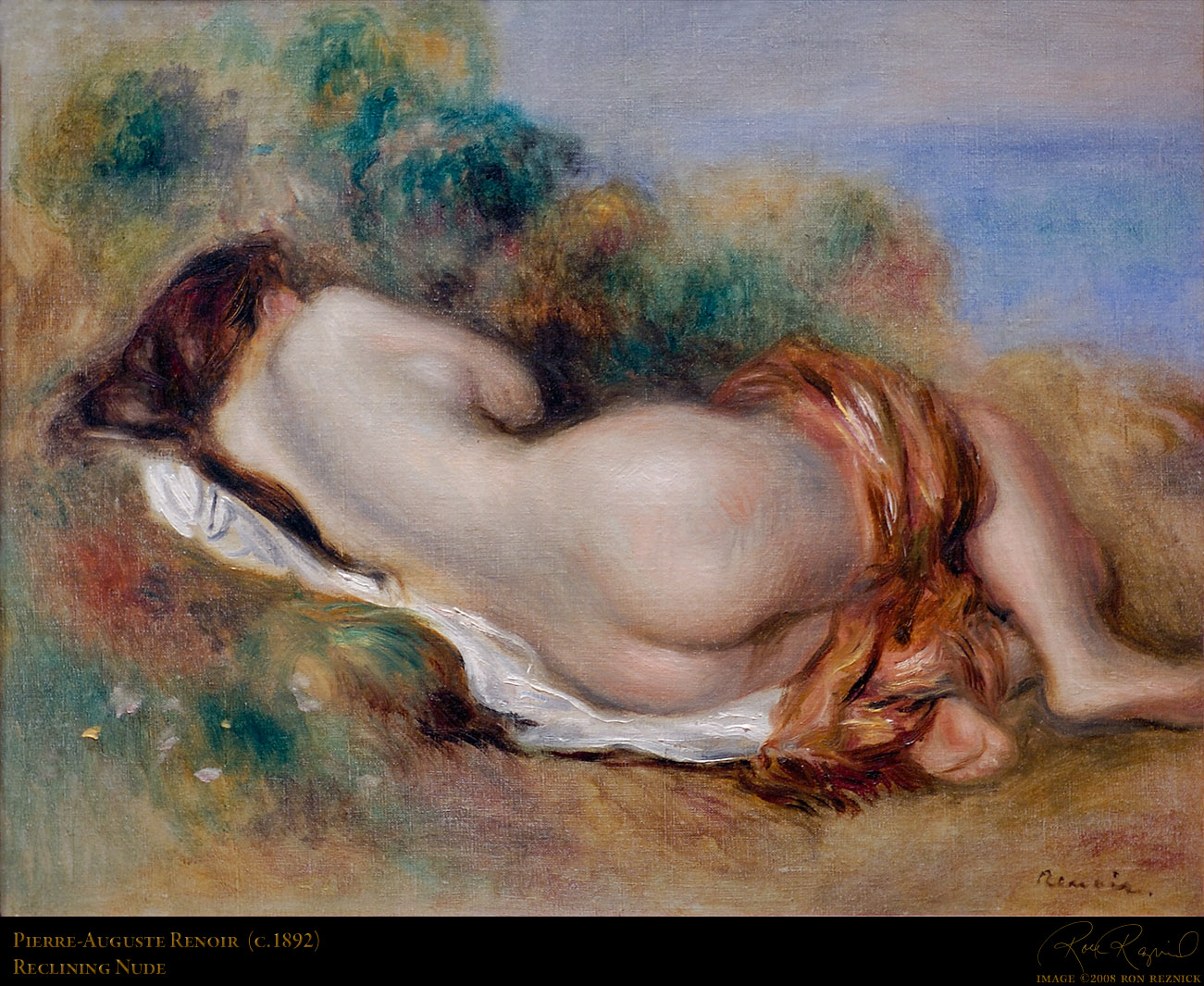
Renoir's "Reclining Nude", sometimes called 'Repose'. I think it captures a bit of both ancient and modern epicureanism. I wonder what she's reading!
Epicurus on Choice

A fundamental belief in epicureanism is that we ALWAYS act to avoid pain and fear. Its just a matter of whether our choices are properly in line with that fact. Ideally, we choose consciously to act so as to avoid pain and fear, and at the same time for the sake of mental and physical repose.  In the end avoiding pain & fear is the same trying to get repose. We can therefore say that when we're doing well we correctly chose to act in order to avoid pain & fear, or that we choose to act so as to have a healthy body and a mind free from disturbance, and mean the same thing.

Its important to note that we're not talking about reflexive responses to fear or pleasure stimuli, certainly not essentially such responses. For instance, in their way of looking at it, fear is an anxious anticipation of something you know is coming.

So while its not right to say that everything we do to achieve this goals is consciously chosen, we do have the ability to be conscious of all things that motivate all the choice-behavior and avoidance-behavior we end up doing. For instance, I may not choose to respond negatively and aggressively when a stranger puts an empty beer glass on my table as he walks by, but I chose to have a drink, I chose to go where I ended up, and as such I presumably chose to be around people who would do such things. When I then act to avoid the pain of being publicly diminished in that way, it shouldn't be too surprising.

Clearly, if I decide that the stranger deserves a beer dumped on them, I've made a bad choice. Yet my actions were an attempt to avoid pain.
 
In what way did Darius choose to get beat up?

 
But how much of  of the things that motivate counter-productive efforts are going to be really chosen in the fully aware way I might, after staring at a draught beer list chose one beer over all the others?

Epicurus would counsel us to recall that there are three types of desires. One type, vain desires, are not "automatic" or "reflexes", ever. We only have them because we in some strong sense of the word chose them.  If you really have to get a Duvel over an Amstel, its not because of some fundamental need of human beings.

Other desires, the merely natural ones, come to us in a sense automatically, like the desire to have something to drink (I don't mean a 'thirst' where you are parched). But we can choose to ignore them almost completely, at least for a time.

And  as for the necessary desires, such as for sustenance, hydration or sleep, though they certainly must be satisfied, we still have a pretty good degree of leeway as to just how or to what extent we will satisfy them beyond the level absolutely required for physical and mental repose. I mean, yes you have to eat, but whether you skip a few meals or add a few extra is up to you.

So in the end, to a very large degree, pretty much everything you do, at least the way in which you do it, is up to you. Even if as a matter of fact you aren't "consciously' choosing to do the thing you are doing at any particular time.

Let's review. According to Epicurus, whether an action is consciously chosen or not, we ALWAYS act to avoid pain and fear.

This conclusion is based on three assumptions so we better see what we think of them.

1. Pleasure is the first good and natural to us. (The number one and original thing everyone seeks out is pleasure).
2. Every pleasure is good, but not every pleasure is something you should choose to get. (Just because sex is good doesn't mean you should sleep with everyone who will sleep with you).
3. Though every pain is an evil, some should not be avoided.

As it turns out, in Epicurus' mind, #2 and #3 are the same point. After all seeking pleasure is avoiding pain, and avoiding pain is seeking pleasure. So if there are some things you shouldn't do, its because they will somehow get rid or pleasure or cause pain even though you'd think they'd do the opposite.  Pleasure, at the end of the day, is "freedom from pain in the body and from trouble in the mind". And we know from experience that some pleasures do lead to pain, and that some pains lead to pleasure. If you're not sure of the last one just think "flu shots" or "blood sample" or even "Listerine".

But the point here is that epicureans believe that if you agree with them that pleasure is the first good, to fulfill your natural desire for pleasure, you will have to avoid some pleasures to get pleasure. We need to avoid "pain-creating pleasures" and even purse "pleasure-creating  pains".

I think that's already a good lesson but if it seems obvious to you, don't worry. I assure you its deeper than that. To see how smart this actually is, next time we will consider what it really means that we ALWAYS act to avoid pain and fear and to get pleasure.

Saturday, October 16, 2010

Lucretius' Conception of Mind

A Recap and a Rolling Start

As I said last time, Lucretius believes that when the mind is pushed-upon a wave of particles sets in motion, stirring the will. If you read my posts on Plato this should remind you of Plato's similar claims on how the outside world impinges upon the mind and body.

But to "stir the will" has to be explained in physical terms too, and Lucretius comes up with a theoretical physical system called "vital spirit" to do so. More on that later but for now we'll note that the physical substance vital spirit is diffused throughout out the body.

Whatever you call the stuff that moves the body around, the real trick is explaining the interconnectedness of the body and mind, of will and physical action, in a thoroughly materialist, physiologically centered manner. And a good, useful explanation will allow us to understand what it means for the mind to see and understand anything at all. Unless you're up to date on current neurophysiology, this is a pretty tall task.

So yeah, Lucretius has to be pretty bright to come up with such a system nearly 2000 years ago.

But enough back-slapping.

Isn't Physical "Soul" a cop-out?

On Lucretius' account every living thing is replete with "soul", which is completely material, just as much as your foot, ear and every other part of your body. (So don't you who believe in immaterial souls try to hijack this, and don't those of you who eschew such talk get upset!). Material soul is not a cop-out, but I'm going to tell you right now the concept gets pretty hairy so we're going take it nice and slow.

Lucretius actually uses two terms that can be translated into English as "soul": anima, which, for you religious types, is the one traditionally equated with what you mean by soul, and animus, a newer (relatively!) term he uses to make a very novel distinction.

Most simply put, in Lucretius' theory its the difference between the irrational and the rational mind. But even this is hiding some serious complexity. Both the "irrational" anima and the "rational" animus are part of (or two types of) the same stuff, vital spirit. Vital spirit is an admixture of various physical elements and, as I said above, is distributed throughout the body. We'll see that actually it works in a way similar to the central and sympathetic nervous systems. First lets focus on the part of all this that is most accessible to us, the animus, the rational part, what Plato and Aristotle called the psyche.

Animus or Psyche, its the Mind for Plato, Aristotle and Lucretius

For Lucretius, the animus, the rational part of the vital spirit, is responsible for all higher cognitive functions, things like abstract thought and planning ahead. So an able translation of animus is "mind', with all its implications of higher order thought and moral understanding. Lucretius at times also calls it "intellect", "head", "guiding principle" and "dominant force".

As funny as it may seem, Lucretius believed, (like many of his contemporaries, Aristotle and Homer) that mind is located in the middle of the breast. It will be very useful to keep that in mind so you can picture how he can talk about "thinking" in your chest, which will help you to better understand him overall. But let me say it again - like the rest of the vital spirit - mind is composed of matter.

A Primer on Mental Activity

Lucretius makes it clear that vital spirit causes sensibility in us, which allows the mind to have experience. And in order for action to occur, the mind must "judge" the benefits/merits of the results of an action. But this does not have to be done consciously. Just as important, the mind is not a 2-way transmitter (e.g., a walkie talkie) that, for example, "feels" a bug crawling on the skin and then tells the hand to squash it.

NO:

Not the way the mind and body interact

Think about why he is right that this doesn't make sense. If the mind were like a walkie-talkie, by definition only one end at a time can communicate. So if you had a bug on your leg, what would have to happen for you to get rid of it?

First, the body would feel the pressure on your flesh. For your mind to "know it" too would require one of four things:
1) Luckily, at the same moment when the body felt the pressure, the mind happened to not communicating out any messages and so able to receive transmission,
2) The body would not only feel the pressure on the skin, but also "knows" that the mind should stop transmitting and could force it to by accompanying important messages with a message such as "over" to tell the brain to start talking,
3) The body itself would just "know" how to stop the bug (like a reflex),
4) The body is constantly transmitting messages whether or not the mind is in a position to hear them, and sometimes the brain listens in for whatever reason.

However plausible you find any of these explanations, they raise more questions than they answer. Instead, Lucretius, like Plato and Aristotle, thinks there is a special, interactive and reciprocal communication between the body and the mind (and the emotions), a process I will continue to refer to as duplex communication. The mind and the body are both duplex transmitters, such as cellular phones, which allow two constantly running communications to both be understood by their targets.

YES:


For Lucretius, Plato and Aristole, how the mind and body interact

More Details on Mind and Thought

According to Lucretius, mind is able to represent events to itself much faster than they actually occur or would happen. For example, if in real life, if Tim Lincecum throws his two-seam fastball 90 miles per hour, the hitter has .46 seconds to swing at it. Go ahead and imagine that now.


Big Time Timmy Jim

However long you took to visualize it, says Lucretius, it was quite a bit faster than .46 seconds. Another example of the relative speed of mind is how long it takes for the mind to "think ahead", as when you get a joke before its completed. (Here's an article on thought-speed).

I'll get into it more in the next post, but this also relates to something that will be very important to the P-A-L theory (when I finally flesh it out!). Not only is Lucretius really big on how fast mental representation is, he also makes it pretty clear that for the mind to "see" doesn't require deliberation. As he puts it, "within one moment of our sensation, many tinier moments are hidden whose existence reason discovers". And what he means by "discovers" is that the contents of our mental pictures are full of information "right there" and only need to be picked up or picked out. Yet we also superimpose assumptions on the information we process with our minds, so that things not "perceived by the senses" seem to us just like sense perceptions.

But what of it? Well it means that for Lucretius some (maybe even most) things are understood by the senses and not just "passively received" by them. And that means that a lot of what you might call "analysis" or "judging" doesn't require conscious deliberation. And as far as ethics goes, it also means that he is in agreement with Epicurus' saying that in a way we choose to engage in poor or irrational behavior because we often have a strong will to impose questionable - or even flat out wrong - interpretations on the things we see and hear.

We'll come back next time to look at the anima and more fully understand vital spirit.